
Facing domestic violence charges in California is disorienting. The legal system moves fast, and decisions made in the first few hours shape everything that follows.
Below, we cover what domestic violence charges mean under California law, what to expect after an arrest, and why the attorney you call first matters.
What Are Domestic Violence Charges in California?
Domestic violence charges in California cover criminal offenses involving people in close personal relationships: spouses, dating partners, cohabitants, and co-parents.
Two statutes come up most often.
- Penal Code 273.5 covers corporal injury to a spouse or cohabitant. It is commonly charged as a felony when there is a visible injury, even a minor one.
- Penal Code 243(e)(1) covers domestic battery: any willful and unlawful touching of an intimate partner that is harmful or offensive, even without visible injury. That charge is typically filed as a misdemeanor.
California law does not require serious physical harm for an arrest to happen. A complaint, a visible mark, or a responding officer’s judgment can be enough.

What Happens After a Domestic Violence Arrest?
California operates under a mandatory arrest policy in domestic violence calls. When law enforcement responds and finds probable cause (a visible injury, a credible complaint, or signs of a physical altercation), an arrest is required. The responding officer has no discretion to let both parties cool off and walk away.
Once arrested, the person taken into custody is booked and held. What to know when accused of domestic violence goes well beyond the arrest itself. Before release, a judge typically issues an emergency protective order that goes into effect immediately. It can prohibit contact with the alleged victim, restrict where the arrested person can live, and limit access to shared children.
The arraignment usually follows within 48 to 72 hours, and if you have not yet consulted a Los Angeles domestic violence attorney, that hearing is closer than you think.
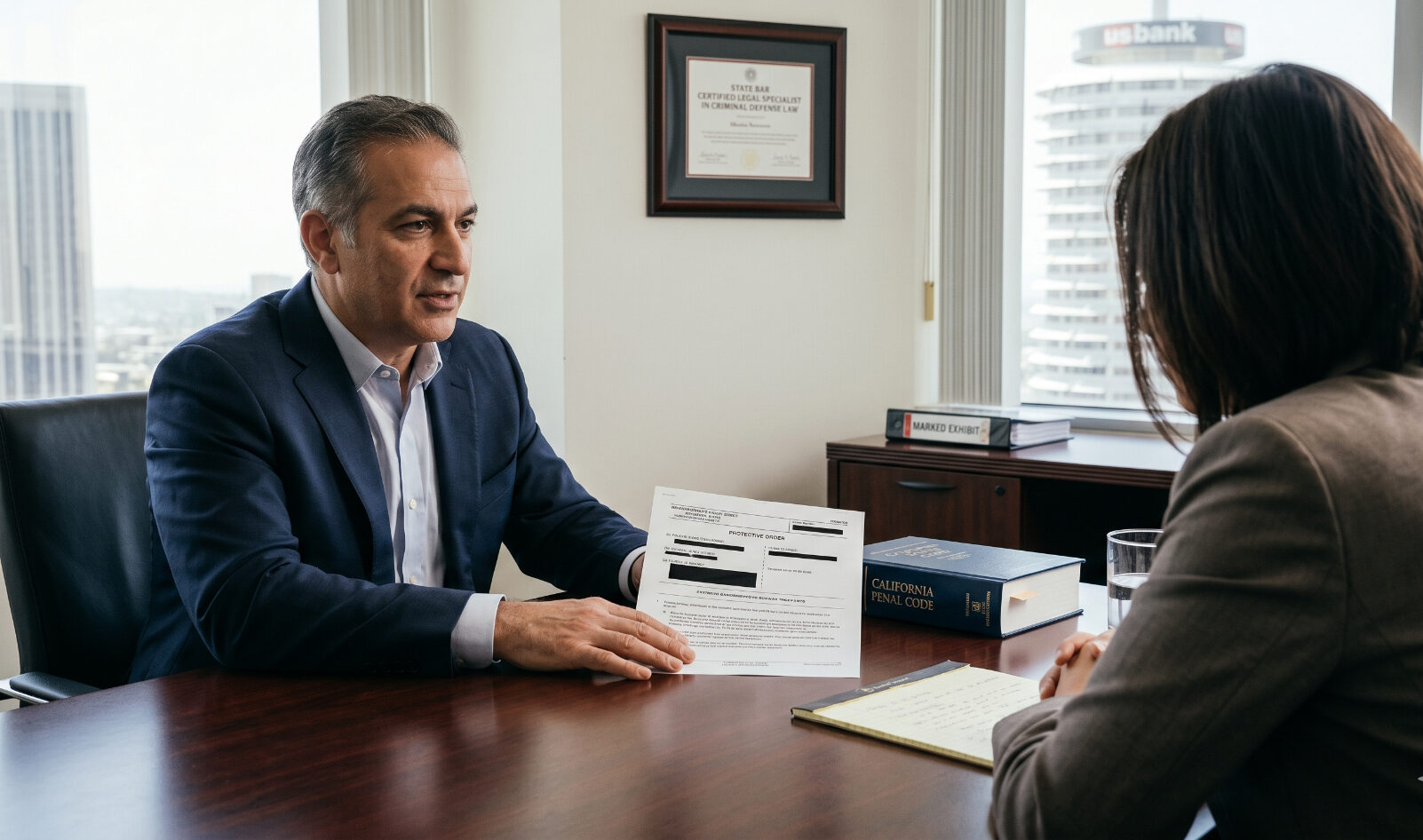
Domestic Violence Bail and Release Conditions
Domestic violence bail in California is not always straightforward. Bail amounts vary by county, charge severity, and criminal history. In Los Angeles County, a felony charge under PC 273.5 carries a higher bail schedule than a misdemeanor battery charge.
Even after release, conditions apply. A criminal protective order, separate from the emergency protective order issued at arrest, may remain in effect throughout the case. Violating it, even accidentally, can result in new criminal charges. Other common release conditions include no contact with the alleged victim, surrender of firearms, and mandatory check-ins.
Penalties for a Domestic Violence Conviction
The domestic violence arrest consequences in California reach well beyond the courtroom. For a misdemeanor conviction under PC 243(e)(1), penalties can include up to one year in county jail, fines, probation, and mandatory completion of a batterer intervention program, typically 52 weeks. A felony conviction under PC 273.5 can mean 2 to 4 years in state prison.
A conviction also creates a criminal record that surfaces in background checks and professional licensing reviews. Child custody is directly affected; California courts treat domestic violence convictions as evidence against the convicted parent in custody disputes. For non-citizens, immigration consequences can be severe. A long-term restraining order may also be issued at sentencing.
These domestic violence arrest consequences apply to first-time offenders. Prior convictions escalate every one of them.
Can Domestic Violence Charges Be Dropped?
This question comes up in nearly every case, and the answer is more complicated than most people expect.
Can domestic violence charges be dropped? In California, once charges are filed, only the prosecutor can drop them. The alleged victim does not control that decision. Even if the complaining party recants or refuses to testify, the prosecutor can still move forward.
What can actually influence whether charges are reduced or dismissed: the strength of the evidence, inconsistencies in the initial report, lack of corroborating injury, and the quality of the defense presented early.
A protective order issued at arrest does not have to become permanent. Restraining order defense runs parallel to the criminal case and should be addressed with the same urgency.

Why Early Legal Representation Matters in Domestic Violence Cases?
The domestic violence arrest process California uses moves quickly. Prosecutors begin building their case from the moment of arrest. The arraignment is days away.
Because early decisions can affect the entire case, experienced legal representation matters. Fighting a domestic violence charge effectively means intervening before charges are formally filed, challenging the emergency protective order, identifying weaknesses in the prosecution’s evidence, and preparing a defense strategy before arraignment. Waiting until after you have entered a plea narrows every option available to you.
Manshoory Law Group focuses exclusively on criminal defense in Los Angeles, Orange County, and San Bernardino County. Lead attorney Shaheen F. Manshoory holds the designation of State Bar Certified Legal Specialist in Criminal Defense Law, one of the rarest credentials in California criminal defense. The firm offers a free case analysis and clients receive direct attorney access from day one.
Conclusion
Domestic violence charges carry consequences that reach far beyond a courtroom, into your record, your parental rights, and for some, your immigration status. California law gives prosecutors significant power to move these cases forward regardless of what the complaining party wants.
The decisions you make in the first 24 to 72 hours can define the outcome of your case.
Contact Manshoory Law Group for a free case analysis. Available 24/7 at (877) 977-7750.