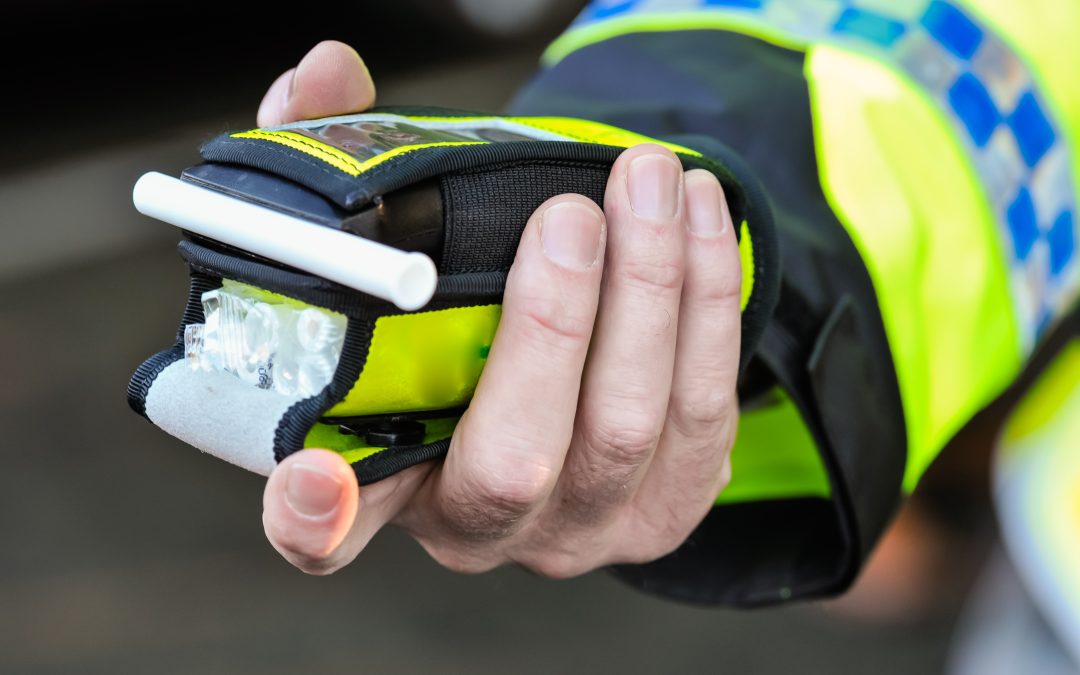
Jun 5, 2026
People often use DUI and DWI as though they mean the same thing, and in California they effectively do. But if you have been charged with an impaired driving offense, or you are trying to understand a charge from another state, the distinction between these terms matters more than most people realize. The specific offense charged can affect available defenses, penalties, and how the offense appears on your record.
Read on for a breakdown of what each term means, how California’s approach differs from other states, and what you are realistically facing if you have been charged.
What Is the Difference Between DUI and DWI?

DUI stands for driving under the influence. DWI stands for driving while intoxicated or, in some states, driving while impaired. The underlying conduct they describe is largely the same: operating a vehicle while your ability to drive is compromised by alcohol, drugs, or a combination of both. The difference is in how individual states have chosen to label and codify that conduct.
In states that use both terms, they are often assigned to different levels of severity. Some states reserve DWI for higher blood alcohol concentrations or more serious impairment, while DUI is applied to lower-level offenses. Others use the two terms for different categories of impairment, for example DUI for drug-related driving and DWI for alcohol-related driving.
The practical takeaway: when someone asks whether a DUI or DWI is worse, the answer depends entirely on which state issued the charge and how that state’s law defines each term. In California, the question does not arise because the state uses only one term.
How California Treats DUI and DWI
California does not have a separate DWI statute. All impaired driving offenses in the state fall under Vehicle Code 23152 , which governs driving under the influence. The law covers alcohol impairment, drug impairment, and combinations of both under the same code section. Whether the impairing substance was alcohol, a prescription medication, marijuana, or an illegal drug, the charge will appear on your record as a DUI.
California sets the blood alcohol concentration limit at 0.08 percent for most drivers. However, a driver can be charged with a DUI even below that threshold if the prosecution can show that their ability to drive safely was actually impaired. The 0.08 limit creates a legal presumption of impairment, but it is not a floor below which charges cannot be brought.
Three categories of drivers face lower or stricter BAC standards under California law:
- Drivers under 21: California’s zero-tolerance policy makes it a violation to drive with a BAC of 0.01 percent or higher. A separate charge under Vehicle Code 23136 applies even when there is no evidence of actual impairment.
- Commercial drivers: The legal limit is 0.04 percent when operating a commercial vehicle, reflecting the higher duty of care expected of professional drivers.
- Drivers on DUI probation: Anyone serving DUI probation faces a 0.01 percent limit, meaning any detectable alcohol in their system can result in a probation violation on top of a new charge.
Other Impaired Driving Terms by State
DUI and DWI are the two most widely used terms, but several other acronyms appear across different states. Understanding them matters if you have a prior conviction from another state, because California courts and the DMV treat out-of-state convictions as equivalent to California DUIs in most circumstances.
| State(s) |
Term Used |
Notes |
| California, Florida, Illinois |
DUI |
Covers both alcohol and drug impairment |
| Texas, Missouri, New York |
DWI |
DWI = driving while intoxicated; some states also use DUI for lesser offenses |
| Iowa, Wisconsin, Indiana |
OWI |
Operating while intoxicated; applies even when vehicle is parked |
| New Jersey |
DWI only |
No separate DUI statute; DWI covers all impaired driving |
OWI, or operating while intoxicated, is used in several Midwestern states and is actually broader than DUI in some respects. In some jurisdictions, OWI statutes may apply even when the vehicle is stationary if the driver is considered to be operating or in actual physical control of the vehicle. A person sitting in the driver’s seat with the engine running may qualify under an OWI statute even if the car never moved.
If you were arrested while impaired by marijuana or another substance rather than alcohol, the charge in California still falls under the DUI statute. The legal standards for drug impairment behind the wheel are covered in detail in what California law says about driving high.
Factors That Determine a DUI or DWI Charge
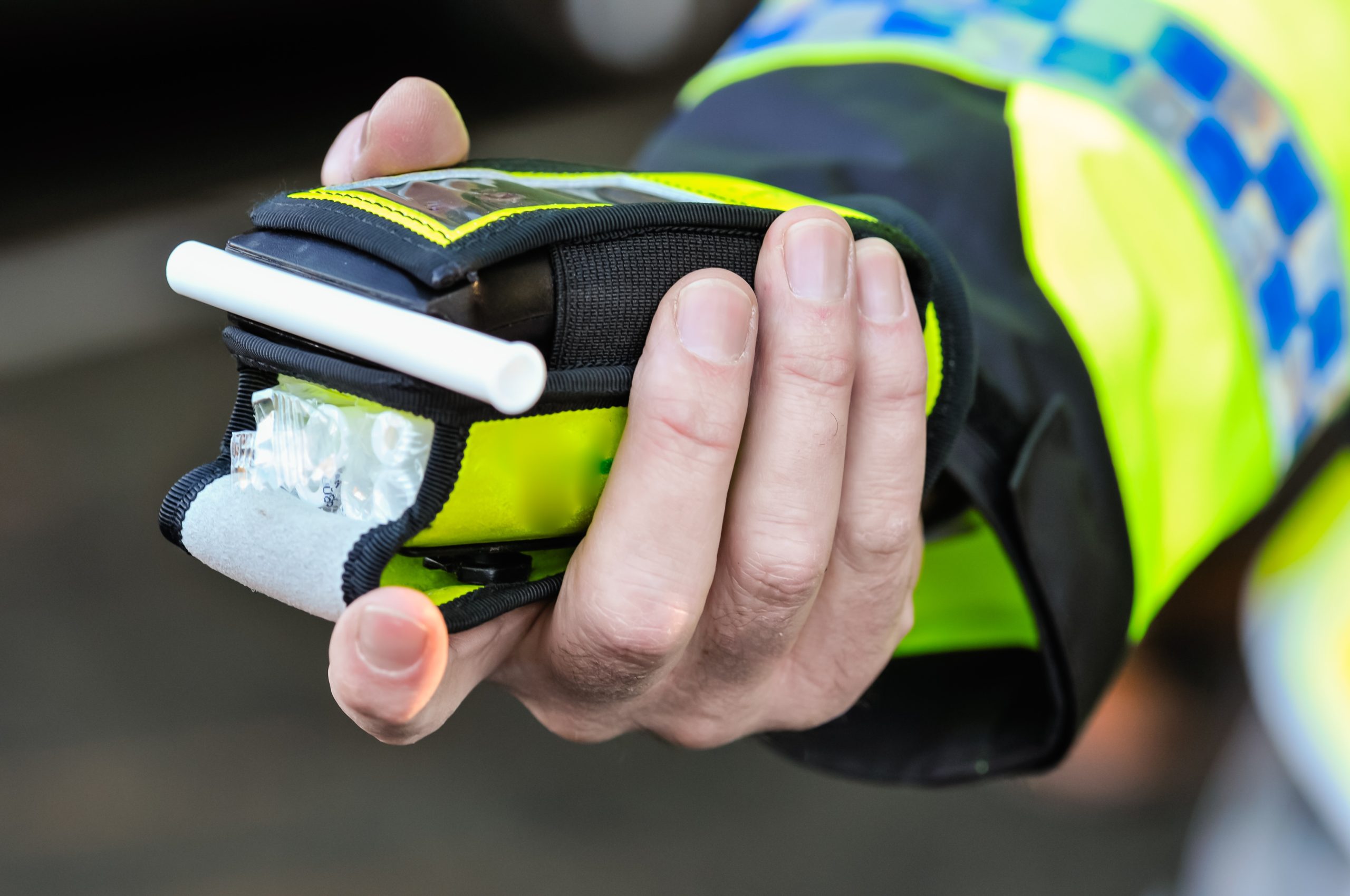
Regardless of the label, the factors that drive how an impaired driving charge is prosecuted are consistent across jurisdictions. In California, the following factors carry the most weight in determining how serious the charge will be:
- BAC at time of arrest: A BAC at or above 0.08 percent triggers the legal presumption of impairment. A BAC of 0.15 percent or higher is treated as an aggravating factor that can increase penalties even on a first offense.
- Number of prior offenses: California looks back 10 years for prior DUI convictions when determining how a new charge is sentenced. A second or third DUI within that window brings escalating mandatory minimums.
- Presence of minors in the vehicle: Driving under the influence with a passenger under 14 years old adds a mandatory jail enhancement under Vehicle Code 23572.
- Injury or property damage: A DUI that causes bodily injury to another person can be charged as a felony under Vehicle Code 23153, regardless of prior record.
- Refusal to submit to chemical testing: California’s implied consent law requires drivers to submit to a blood or breath test after a lawful arrest. Refusal results in an automatic one-year license suspension and can be used as evidence of consciousness of guilt at trial.
- Drug-impaired driving: A drug offense DUI follows the same legal framework as alcohol impairment but introduces different evidentiary challenges, particularly around proving that the substance caused actual impairment at the time of driving.
Penalties for DUI and DWI Offenses
California DUI penalties scale based on the number of prior convictions within the 10-year lookback period and whether the offense caused injury. Here is a summary of standard sentencing ranges for DUI offenses in California:
| Offense |
Jail / Prison |
Fine (approx.) |
License Suspension |
| 1st offense misdemeanor |
Up to 6 months |
$390-$1,000 + penalties |
6 months |
| 2nd offense (10 yrs) |
96 hrs-1 year |
$390-$1,000 + penalties |
2 years |
| 3rd offense (10 yrs) |
120 days-1 year |
$390-$1,000 + penalties |
3 years |
| Felony DUI (4th+/injury) |
16 months-4 years |
Up to $5,000 + penalties |
4 years |
All figures above reflect base statutory ranges. Court-imposed fines are typically multiplied by penalty assessments that can push the total financial cost to three to five times the base fine amount. Additional consequences include mandatory DUI school, installation of an ignition interlock device, probation, and in some cases vehicle impoundment.
A felony DUI conviction also triggers a 10-year ban on firearm possession under California law and has permanent immigration consequences for non-citizens.
How a DUI or DWI Affects Your Insurance
A DUI conviction triggers an SR-22 requirement in California. SR-22 is not an insurance policy but a certificate filed by your insurer with the DMV confirming that you carry at least the minimum required liability coverage. The requirement typically lasts three years from the date your driving privilege is restored.
The insurance premium impact is substantial. Insurers classify a DUI conviction as a high-risk event, and most drivers see their premiums increase by 80 to 100 percent or more at renewal. Some standard market carriers will not renew the policy at all, forcing the driver into the non-standard or assigned risk market where rates are significantly higher.
If you are trying to determine whether your current BAC would put you at risk before getting behind the wheel, the BAC estimator tool can give you a general reference. Keep in mind it is not a substitute for a breathalyzer and California law allows prosecution for impairment even below 0.08 percent.
Frequently Asked Questions
Is a DWI worse than a DUI?
In California, there is no DWI. If you are asking about another state, it depends on how that state defines each term. In states like Texas and New York that use both, DWI is typically the more serious charge, reserved for higher BAC levels or more egregious impairment. In states that only use DWI, it is functionally equivalent to what California calls a DUI.
Does California use DWI or DUI?
California uses DUI exclusively. The term appears in Vehicle Code 23152 and covers all forms of impaired driving, including alcohol, drugs, and combined impairment. If you were arrested for impaired driving anywhere in California, the charge will be filed and recorded as a DUI.
Can a DUI be reduced to a lesser charge in California?
In some circumstances, yes. A DUI can be reduced to reckless driving, commonly called a “wet reckless” under Vehicle Code 23103.5, through a plea negotiation. A wet reckless carries lighter penalties and does not carry the same social stigma as a DUI conviction. However, it still counts as a prior DUI conviction for sentencing purposes if you are charged again within 10 years. Whether a reduction is available depends on the facts of the case, your prior record, and the specific prosecutor involved.
How long does a DUI or DWI stay on your record?
A California DUI conviction stays on your driving record for 10 years from the date of arrest for purposes of prior offense counting. It remains on your criminal record permanently unless you successfully petition for expungement under Penal Code 1203.4. Expungement does not remove the conviction entirely but relieves you of most of the collateral consequences and allows you to state on most job applications that you have not been convicted of that offense. Out-of-state DWI convictions are typically treated as equivalent priors by California courts within the same 10-year window.
Do you need a lawyer for a first-time DUI?
Yes. A first-time DUI in California is a misdemeanor, but it carries real consequences: up to six months in county jail, fines that regularly exceed $2,000 after assessments, a six-month license suspension, mandatory DUI school, and SR-22 insurance requirements. An experienced DUI defense attorney can challenge the legality of the stop, the accuracy of the breathalyzer or blood test, and the admissibility of field sobriety test evidence. For a detailed breakdown of what to expect when you have no prior record, see first offense DUI in California.
Underage drivers face additional consequences beyond the standard DUI penalties. If the driver was under 21 at the time of arrest, the specific implications are covered in what happens after an underage DUI in California.
Charged With a DUI in California?
Whether the term is DUI, DWI, or OWI, an impaired driving conviction follows you for a decade on your driving record and potentially for life on your criminal record. The financial cost, the license consequences, and the insurance impact are significant even on a first offense. The earlier you retain qualified defense counsel, the more options you have to challenge the charge, negotiate a reduction, or minimize the consequences.
Contact Manshoory Law Group for a free case analysis with an attorney who handles DUI defense across Los Angeles and Southern California.

Jun 5, 2026
Getting caught shoplifting sets off a process that moves faster than most people expect. Shoplifting charges California prosecutors file range from misdemeanors to felonies, and depending on the merchandise value and your record, they can follow you for years. Here is what actually happens, and what your options are.
What Are Shoplifting Charges Under California Law?
California defines shoplifting under Penal Code 459.5 as entering a commercial establishment during business hours with the intent to steal merchandise valued at $950 or less. Above that threshold, the charge typically escalates to grand theft under Penal Code 484 or burglary.
Shoplifting in California overlaps with petty theft for low-value items and grand theft for higher-value ones. California law also distinguishes between the act of taking merchandise and the intent to do so. This means that you can face these charges even if you are stopped before leaving the store. Understanding larceny vs. theft in California clarifies how shoplifting relates to the broader category of theft offenses prosecutors can file depending on the circumstances.
Prop 47, passed in 2014, reclassified most shoplifting of items under $950 as a misdemeanor rather than a felony. That said, misdemeanor does not mean consequence-free.
What Happens Immediately After Getting Caught Shoplifting?
Most shoplifting cases begin with loss prevention. Store security has the legal right to detain you if they have reasonable grounds to suspect theft, sometimes called the “shopkeeper’s privilege.” During that detention, they may review footage, ask questions, and document what was taken.
Understanding the shoplifting arrest consequences before you face them helps. From the moment you are detained, several things happen simultaneously:
- Police contact. Loss prevention may call law enforcement, especially for higher-value merchandise or if you have prior incidents on file with the store. An officer can issue a citation, make an arrest, or release you with a notice to appear.
- Civil demand letter. California law allows retailers to send a civil demand letter seeking compensation (typically $50 to $500) regardless of whether criminal charges are filed. Paying it does not eliminate criminal exposure.
- Booking and arraignment. If arrested, you will be booked and eventually arraigned. That is the first court appearance where charges are formally read and you enter a plea.
What you say to loss prevention or law enforcement can be used against you. Remaining calm and saying nothing beyond basic identification is almost always the right call.

Misdemeanor vs. Felony Shoplifting Charges
Under Penal Code 459.5, a first-time shoplifting offense in California involving merchandise under $950 is typically charged as a misdemeanor. Several factors can push charges higher:
- Merchandise valued over $950 can result in felony grand theft or commercial burglary charges.
- Certain prior convictions can eliminate misdemeanor eligibility even under Proposition 47.
- Using force or working with others can elevate charges significantly.
- Some theft-related charges are wobblers, giving prosecutors discretion to file as a misdemeanor or felony based on the facts.
The distinction matters because felony charges carry far more severe consequences and can affect professional licensing, immigration status, and housing in ways a misdemeanor often does not. The line between misdemeanor shoplifting and felony territory is where petty and grand theft defense strategy begins to differ significantly.

Penalties for Shoplifting Charges in California
Shoplifting penalties California courts impose depend on whether the charge is a misdemeanor or felony.
- Misdemeanor shoplifting penalties can include up to 6 months in county jail, fines up to $1,000, probation, restitution to the retailer, and community service.
- Felony shoplifting or grand theft penalties can include 16 months to 3 years in state prison, significantly higher fines, and formal probation.
Beyond the sentence, a conviction creates a criminal record affecting employment, professional licenses, housing, and immigration status for non-citizens. First offense shoplifting California cases sometimes result in diversion programs that keep a conviction off your record, but that outcome depends on the facts and how the case is handled.

Can Shoplifting Charges Be Dropped or Dismissed?
Shoplifting charges are not always final. Can shoplifting charges be dropped? In many cases, they can.
- Diversion programs. California courts offer diversion in many first-offense cases. Complete the program (community service, theft education, and staying out of trouble), and the charges are dismissed without a conviction.
- Lack of intent. Shoplifting requires intent to steal at the time of entry. If the evidence does not support that intent, whether due to an honest mistake, distraction, or self-checkout confusion, that can be a viable defense.
- Insufficient evidence. Loss prevention footage is not always clear or conclusive. If the evidence is weak, a defense attorney can challenge whether the prosecution can prove the case beyond a reasonable doubt.
- Plea bargain. Negotiating with the prosecutor can result in reduced charges, sometimes to a lesser infraction, particularly for first-time offenders.
People who handle these cases alone often miss options that an experienced attorney would identify early.
Why You Should Not Face Shoplifting Charges Alone
These charges are not automatically minor. A misdemeanor conviction stays on your record and shows up on background checks. For non-citizens, even a petty theft conviction can trigger immigration consequences. For licensed professionals, it can raise licensing board issues. The full range of shoplifting arrest consequences (criminal, civil, and collateral) is wider than most people anticipate.
What looks like a simple case often has more moving parts than it appears. A Los Angeles Theft Crimes Attorney reviews the evidence, checks how the detention was conducted, and determines whether diversion, dismissal, or a negotiated reduction is realistic.
Manshoory Law Group handles theft defense across the Southern California courts where these cases are filed. Lead attorney Shaheen Manshoory holds California State Bar Certification in Criminal Defense Law, one of the rarest credentials in the state.
The right time to get legal help is before your first court appearance.
Conclusion
These cases move faster than most people expect. Loss prevention contacts the police. Prosecutors file charges. Before you have fully processed what happened, you are facing a court date with consequences that can extend well beyond the courtroom: into your record, your employment, and in some cases your immigration status.
The difference between a conviction and a dismissed case often comes down to when you involve an attorney. Early intervention opens options that disappear once the case advances.
If you are facing shoplifting charges in Los Angeles, Orange County, or San Bernardino County, contact Manshoory Law Group for a free case analysis. Available 24/7 at (877) 977-7750.

Jun 5, 2026
Being arrested or charged with a crime in California is one of the most stressful situations a person can face. The attorney you hire can significantly influence the outcome of your case, from bail hearings and arraignment through trial or plea negotiations. Not all criminal defense lawyers offer the same level of skill, experience, or commitment. Knowing what separates a good attorney from the best criminal defense attorney in California and what to look for before signing anything can make a consequential difference.
What Makes a Great Criminal Defense Attorney in California?

The best criminal defense attorneys share a specific combination of traits that go beyond having a law license. Experience matters, but experience alone is not enough. What matters is the right kind of experience for your type of case.
Strong attorneys understand how California courts actually operate, not just how they are supposed to operate. They have relationships with prosecutors, know the local judges, and understand how evidence is typically handled in the jurisdiction where your case will be heard. They are also willing to take a case to trial when that is the right strategy, rather than always pushing toward a plea.
Communication is equally important. The right attorney keeps you informed at every stage, explains your options in plain language, and responds when you reach out. You should never feel like a bystander in your own case.
Before your first meeting with any attorney, it helps to know the stages of a criminal case, from arrest through arraignment, hearings, and ultimately trial or plea.
Key Credentials and Qualifications to Look For
California does not require criminal defense attorneys to hold any specialist certification, but a few credentials carry real weight when evaluating your options.
California Board of Legal Specialization
The State Bar of California offers a Certified Legal Specialist designation in criminal law through the California Board of Legal Specialization. Attorneys who hold this certification have passed a written exam, demonstrated a substantial involvement in criminal law over at least five years, and received favorable evaluations from other attorneys and judges. It is one of the strongest independent signals of criminal law competence available in California.
Trial Experience
Ask directly: how many jury trials has this attorney handled? An attorney who settles every case because they avoid courtrooms is a very different proposition from one who has tried dozens of felony cases. Trial experience also strengthens plea negotiations, because prosecutors know they are dealing with someone who is prepared to go to trial if a fair deal is not offered.
Former Prosecutor Background
Some of the most effective defense attorneys are former prosecutors. They understand how the other side builds a case, which evidence prosecutors prioritize, and where investigations commonly fall short. That inside perspective can be a genuine advantage, particularly in complex or serious felony cases.
Verified Reviews and Peer Recognition
Peer review ratings from organizations like Martindale-Hubbell, inclusion in Super Lawyers, and verified client reviews across multiple platforms all point in the same direction when an attorney is genuinely well-regarded. A single award can be bought or gamed, but a consistent pattern across independent sources is harder to manufacture.
How Much Does a Criminal Defense Attorney Cost in California?
Attorney fees in California vary significantly based on the charge, the complexity of the case, the attorney’s experience level, and the geography. Here is a general framework:
- Misdemeanor cases: Flat fees typically range from $1,500 to $5,000 for a straightforward misdemeanor. Cases that go to trial will cost more.
- Felony cases: Fees generally start around $5,000 to $10,000 for less complex felonies and can reach $25,000 or more for serious charges that go to trial.
- Federal charges: Federal criminal defense is considerably more expensive given the complexity of federal proceedings. Retainers of $20,000 or more are not unusual.
- Hourly billing: Some attorneys charge hourly rather than a flat fee, typically between $200 and $500 per hour in California.
Cost is a real consideration, but it should not be the primary one when the stakes involve your freedom and your record. An attorney who charges less but lacks trial experience or local court relationships may end up costing far more in the long run.
Many firms offer payment plans, and some offer a free initial case analysis so you can evaluate fit before committing.
Questions to Ask Before Hiring a Criminal Defense Lawyer
Your first consultation reveals more than an attorney’s credentials; it shows how they think, how they communicate, and whether they take your case seriously. Come prepared with specific questions:
- How many cases similar to mine have you handled in California, and what were the outcomes?
- Will you personally handle my case, or will it be passed to a junior associate?
- How do you communicate with clients, and how quickly do you typically respond to calls or messages?
- What is your assessment of my situation based on what I have told you today?
- What are the likely paths this case could take, and what is your recommended strategy?
- How does your fee structure work, and what is included?
Pay attention to how an attorney answers these questions as much as what they say. An attorney who listens carefully, gives you a straight read on your situation, and avoids overpromising is a better sign than one who guarantees outcomes or speaks only in vague generalities.
Public Defender vs. Private Criminal Defense Attorney
If you qualify financially, the court will appoint a public defender at no cost to you. Public defenders are licensed California attorneys and many are genuinely skilled at criminal defense. The honest constraint is caseload. Public defenders in California often handle hundreds of active cases simultaneously, which limits the time available for each client, independent investigation, and trial preparation.
A private criminal defense attorney typically brings more available time, more resources for investigation and expert witnesses, and the ability to focus on your specific case from the beginning. That difference is most significant in cases involving serious felony charges, complex fact patterns, or situations where the outcome will have major consequences for your employment, immigration status, or professional license.
If the charge you are facing could affect your record long term, it is also worth understanding your options for expungement in California once the case resolves.
When Should You Hire a Criminal Defense Attorney?

The short answer is: as early as possible. Many people wait until after arraignment, or even until charges are formally filed, before contacting an attorney. That delay can cost you real options.
Under California Penal Code 825, anyone arrested must be brought before a judge within 48 hours. An attorney retained before arraignment can appear at that hearing, argue for lower bail, and begin building your defense before the prosecution has fully shaped its narrative. Early involvement also matters because witnesses’ memories are freshest, physical evidence has not yet been processed in ways that close off challenges, and investigators can be approached before they have locked in their findings.
Do not wait to be formally charged. If you know you are under investigation, or if law enforcement has contacted you and asked to speak with you, retain counsel before you respond to any questions.
Whatever charge you are facing, having an attorney who handles that specific area makes a real difference. The firm’s full practice area coverage spans DUI, domestic violence, drug offenses, violent crimes, and more.
Why Manshoory Law Group Is California’s Choice for Criminal Defense
Manshoory Law Group has defended clients across Los Angeles and Southern California for over two decades. Shaheen Manshoory is a State Bar Certified Legal Specialist in Criminal Law, one of fewer than 500 attorneys in California to hold that designation. The firm handles cases across the full spectrum of criminal charges, with particular depth in:
- DUI defense, including first offense, multiple DUI, and drug-related driving charges
- Domestic violence charges, including defense at the protective order stage through trial
- Drug crime defense, from simple possession through trafficking allegations
- Felony and misdemeanor defense across Los Angeles, Orange, Riverside, San Bernardino, and Ventura counties
The firm offers 24/7 availability for new clients, free case analysis, and transparent fee structures. If you or someone you know is facing criminal charges in California, contact Manshoory Law Group to speak with an attorney today.
Frequently Asked Questions
What makes a good criminal defense attorney?
Relevant trial experience in California courts, clear communication, a genuine willingness to fight for your interests rather than simply process your case toward a plea, and demonstrated familiarity with the type of charge you face. A certified legal specialist designation in criminal law is a meaningful additional credential.
Do I need a criminal defense attorney in California?
For anything beyond a minor infraction, yes. Misdemeanors can carry jail time, fines, and a criminal record that affects employment and housing. Felonies carry far more severe consequences. Even charges that seem straightforward can become complicated quickly, and having counsel protects your rights throughout the process.
How much does a criminal defense attorney cost in California?
Criminal defense attorney fees vary based on the severity of the charges, the complexity of the evidence, whether expert witnesses or investigators are needed, and whether the case is likely to proceed to trial. Attorneys may charge a flat fee for certain matters or bill hourly for more complex cases. During an initial consultation, most firms can provide a clearer estimate based on the specific facts and circumstances of your case.
Can I change my criminal defense attorney mid-case?
Yes. You have the right to substitute counsel at any point in your case, though doing so close to a scheduled trial date can create complications. If you are unhappy with how your current attorney is handling your case, the sooner you address that the better. A new attorney will need time to review the record and get up to speed.
What is the difference between a public defender and a private defense attorney?
Both are licensed attorneys. The practical difference is caseload and available resources. Public defenders often carry extremely high caseloads that limit the time and attention available for each client. A private attorney takes on fewer cases and can dedicate more time to investigation, preparation, and court appearances specific to your matter.
The Right Attorney Changes Everything
Criminal charges in California can follow you for years. The attorney you choose at the beginning of this process will shape how far those consequences reach. Look for verified courtroom experience, clear communication, and a genuine track record in the type of case you are facing. Reach out to Manshoory Law Group for a free case analysis. The sooner you get qualified counsel involved, the more options you will have.

May 29, 2026
A call from the San Bernardino Police Department is not the beginning of a legal process most people have thought through. For many defendants, the first hours are the most disorienting: booking, questions, and a holding cell before the case formally enters the criminal system.
If you or someone close to you is facing assault and battery charges in San Bernardino, understanding what happens next and why the early decisions matter is one of the most important things to understand.
How Assault and Battery Arrests Are Processed in San Bernardino
After a San Bernardino Police Department battery arrest, the immediate sequence is fairly predictable:
- You are transported to a local facility for booking.
- Your information is entered into the system and personal property is collected.
- A bail amount is set based on the charge and your criminal history. Prior convictions tend to drive that number up significantly.
At arraignment, typically within 48 to 72 hours of arrest, you appear before a judge and enter your plea. This is your first formal interaction with the court. Many defendants arrive without counsel, which is one of the more consequential mistakes in the early stages.
A defense attorney can often challenge bail amounts or conditions at this point and begin shaping how the case is framed before the San Bernardino County District Attorney’s office files formal charges.
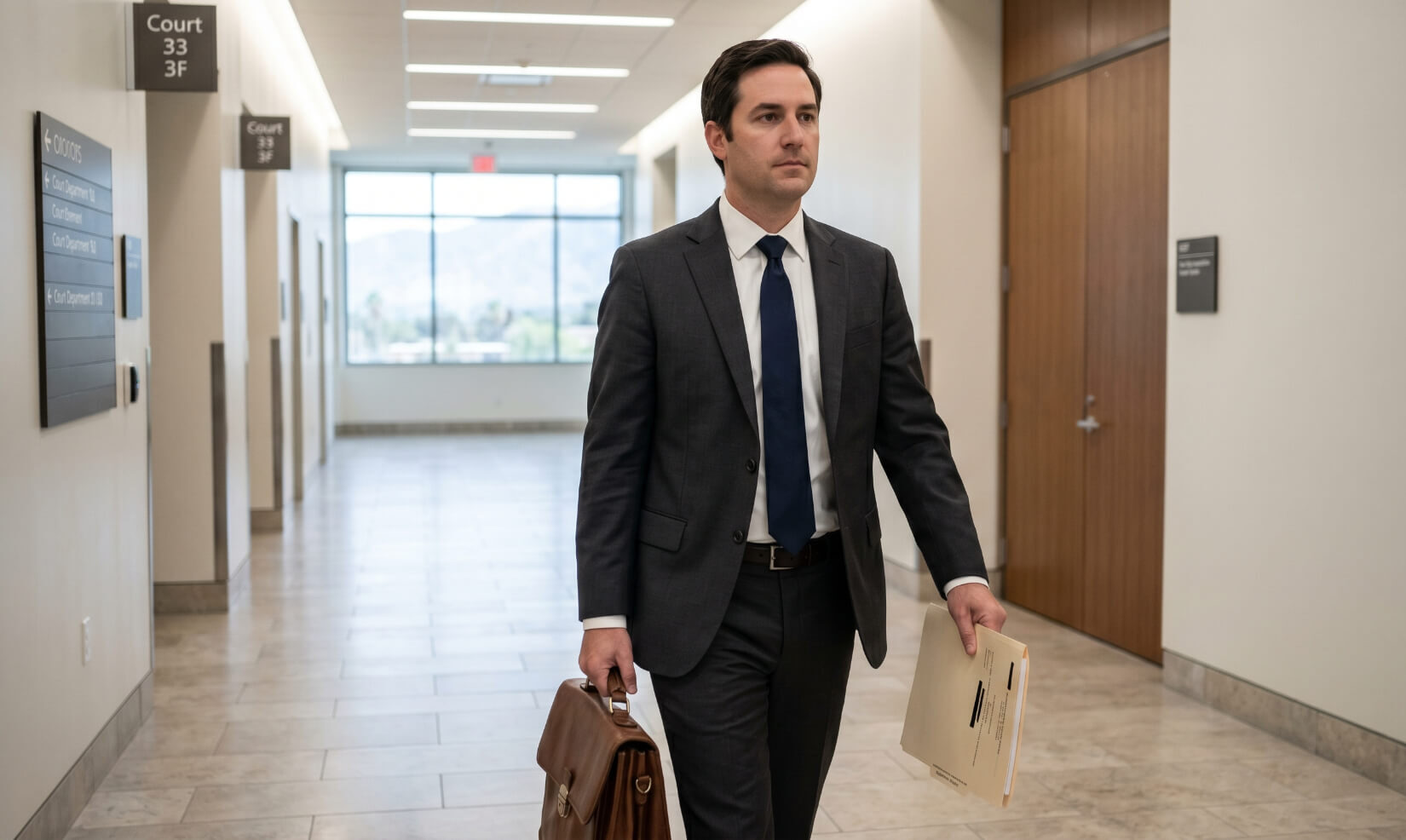
Where San Bernardino Assault Cases Are Heard: San Bernardino Superior Court
San Bernardino Superior Court handles misdemeanor and felony assault matters filed throughout the county and serves a large portion of the Inland Empire. A San Bernardino Superior Court assault case typically begins at arraignment and proceeds through pre-trial hearings, negotiations, and potentially trial if no resolution is reached.
Local court experience can influence how a case is handled. Attorneys who regularly appear in these courtrooms often understand procedural expectations and how certain arguments are received. For assault and battery defense, familiarity with local practices can create opportunities for stronger negotiations and early strategic decisions.
Assault vs. Battery: What the Charge Means in the Inland Empire
California law treats assault and battery as related but legally distinct charges:
- Simple assault, under Penal Code 240, involves an unlawful attempt to commit a violent injury on another person. You do not need to make physical contact for an assault charge to apply. Simple assault defense in California often turns on whether the prosecution can establish that both the intent and the present ability to carry out that force existed at the same moment.
- Simple battery, under Penal Code 242, requires actual physical contact, but that contact does not have to cause injury.
- Battery penalties and escalation are addressed under Penal Code 243, which governs how aggravating factors affect the charge level.
Beyond the basic definitions, the circumstances often determine charging decisions. Domestic battery carries different collateral consequences than a bar fight. Aggravated assault involving use of force, a weapon, or bodily injury can elevate a misdemeanor into a felony wobbler offense, meaning prosecutors have discretion over how it gets charged. A criminal threat charge can run alongside the assault allegation depending on what was said.

Penalties for Assault and Battery Charges in San Bernardino
Penalties for assault and battery charges in San Bernardino depend on the facts of the case, prior convictions, and whether the charge is filed as a misdemeanor or felony.
Common consequences may include jail time, fines, probation, and court-ordered conditions. More serious cases involving weapons, repeat offenses, or significant bodily injury can lead to felony exposure and longer sentences.
Beyond court penalties, a conviction can create a lasting criminal record that affects employment, licensing, housing, and immigration status. For many defendants, the difference between a misdemeanor and felony outcome carries consequences that extend far beyond sentencing.

Can San Bernardino Assault and Battery Charges Be Reduced or Dismissed?
Yes, and this happens more often than many defendants expect when a defense attorney is involved early. Several paths exist depending on the facts:
- Plea bargain: Prosecutors routinely offer reduced charges when the evidence is contested or mitigating factors support a lower charge.
- Diversion program: Some defendants with limited prior criminal records may qualify, allowing them to avoid a conviction appearing on their record entirely if they complete certain requirements.
- Dismissal: Cases built on inconsistent witness testimony, lack of corroboration, or evidentiary problems do not always survive pre-trial scrutiny.
For battery charges specifically, the question of what the complainant can actually establish in court is often more complicated than the initial arrest report suggests. The earlier a defense attorney reviews the evidence, the more options typically exist. Understanding your battery defense in California options is a starting point.
How a Defense Attorney Fights Assault Cases in San Bernardino
Assault and battery charges in San Bernardino turn on specifics. A defense attorney examines:
- Who the witnesses are and whether their accounts hold up under scrutiny
- What law enforcement documented at the scene
- Whether consent or self-defense applies under California law
- Whether the prosecution can meet the legal standard for each element of the charge
In domestic battery cases, the dynamic between the complainant and the defendant often shifts after the arrest, and that shift can affect how the prosecution builds its case. In aggravated assault cases, the central question is what force was used and whether it was legally justified.
Manshoory Law Group handles assault and battery defense in San Bernardino County and across the Inland Empire. Lead attorney Shaheen F. Manshoory holds California State Bar Certification in Criminal Defense Law, one of the rarest credentials in the state.
The firm practices exclusively in Southern California, from cases handled by a Los Angeles criminal defense attorney to matters prosecuted in San Bernardino County Superior Court, the focus is the same: criminal defense only, at every stage of the process. If you are facing assault and battery charges in San Bernardino, California, the time to involve counsel is before your arraignment, not after.

Talk to a San Bernardino Criminal Defense Attorney Now
Assault and battery charges in San Bernardino move through the system on a schedule that does not wait for defendants to get ready. The decisions made in the first 48 to 72 hours, arraignment, bail, how you interact with law enforcement, create conditions that defense attorneys either work with or have to fight against.
Manshoory Law Group is available 24/7 and offers a free case analysis to review your situation and explain your options without obligation. Contact a defense attorney now to get started.
May 29, 2026
An arrest for assault or battery in the City of Orange moves quickly. The Orange Police Department makes the arrest, booking follows, and within days a court date is set at the North Justice Center. What happens between the arrest and that first appearance shapes the options available at every stage that follows.
How Assault and Battery Arrests Are Handled in the City of Orange
The Orange Police Department handles assault and battery arrests within city limits. After an arrest, you go through the booking process: fingerprints, photographs, and a review of your criminal record, including prior convictions, which may affect how charges are filed.
From there, the Orange County District Attorney’s office reviews the arrest report and decides what charges to file. That decision shapes everything. A first-time misdemeanor arrest and a repeated felony arrest are processed differently, and the DA’s charging decision reflects that.
Where Orange Assault Cases Go: North Justice Center
Assault and battery charges in Orange are processed at the North Justice Center in Fullerton, the courthouse that handles criminal matters for northern Orange County cities, including Orange. This is where your arraignment will take place, where hearings are scheduled, and where your case will be tried if it reaches trial.
Cases at the North Justice Center are frequently handled by the same prosecutors and judges, which means certain patterns emerge in how assault and battery cases are charged and resolved.
Every defendant at the North Justice Center follows the same procedural stages: arraignment, pretrial hearings, and either resolution or trial. Where your case lands depends on the evidence and defense.
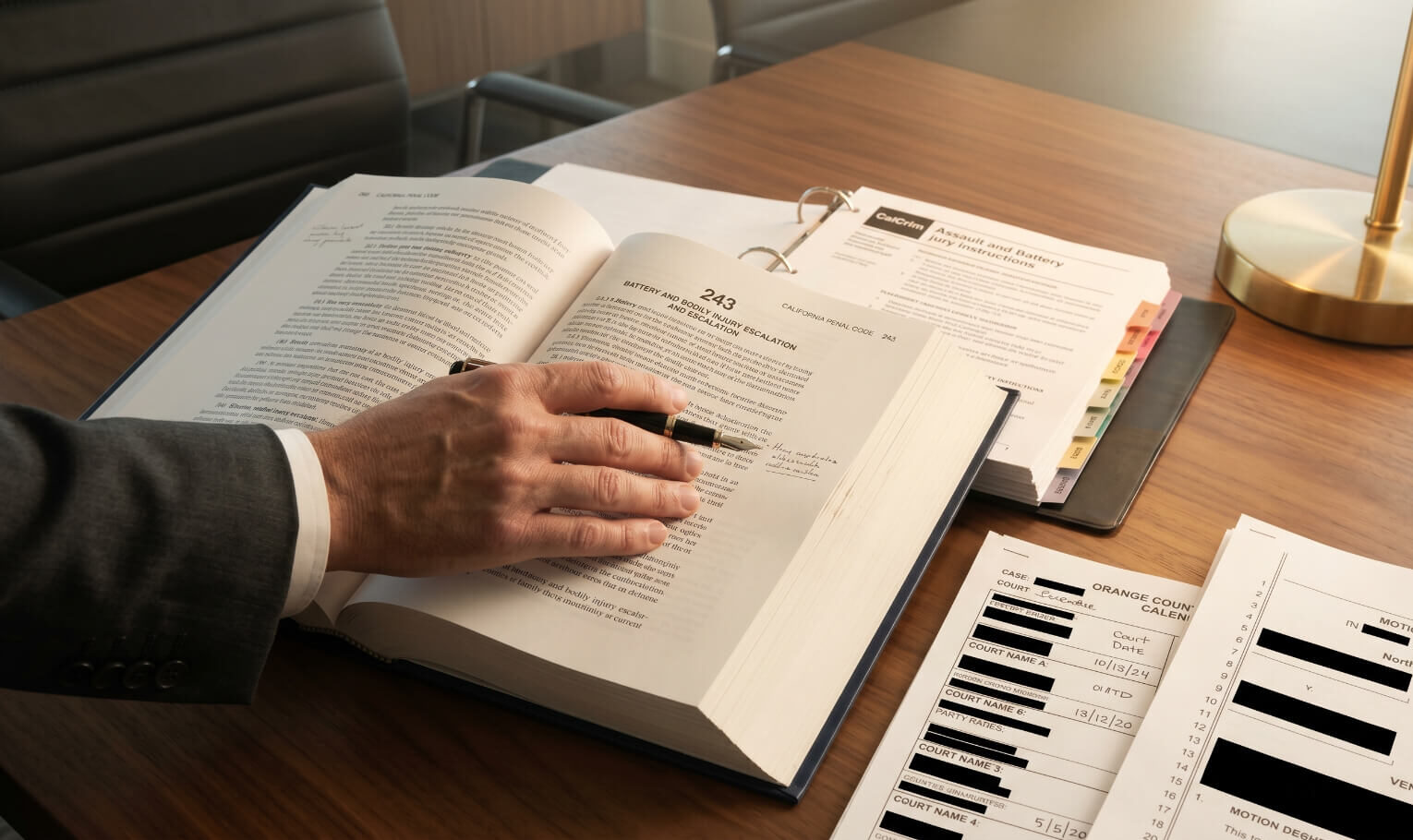
Assault vs. Battery: What the Difference Means for Your Case
California law treats assault and battery as separate offenses, and the distinction affects how a case is charged and defended.
Simple assault (Penal Code 240)
- Physical contact is not required
- An attempt to apply force, paired with the present ability to carry it out, satisfies the elements
Simple battery (Penal Code 242)
- Actual physical contact is required; injury is not
- Even unwanted touching with no resulting harm can meet the standard
Battery causing bodily injury (Penal Code 243)
- Carries heavier penalties than simple battery
- Triggers additional sentencing considerations when bodily injury is established
The line between misdemeanor and felony often comes down to specific facts:
- Whether a weapon was involved
- Whether the alleged victim was a protected person such as a peace officer or healthcare worker
- Whether serious bodily injury resulted
Many assault and battery charges are wobbler offenses, meaning prosecutors have discretion to file either way. That discretion is also where assault and battery defense strategy can intervene most effectively before the charging decision is finalized.

Penalties for Assault and Battery Charges in Orange, California
Penalties for assault and battery charges in Orange, California vary significantly depending on how the charge is filed.
Misdemeanor assault or battery
- Up to six months in county jail
- Fines and probation
- Mandatory counseling in some cases
Aggravated assault or domestic battery with injury
- Potential state prison sentence of two to four years
- Sentencing enhancements for weapon use or victim status
- Mandatory counseling and probation conditions for domestic battery convictions
Beyond incarceration, a conviction carries consequences that outlast the sentence:
- Employment background checks
- Professional licensing complications
- Firearm rights restrictions
- Immigration consequences for non-citizens
Battery charges in Orange, CA are not treated uniformly. A simple battery between strangers is charged and sentenced differently than domestic battery between household members, which triggers mandatory arrest policies and separate sentencing considerations.
A criminal threat charge is a related offense prosecutors sometimes add when threatening statements accompanied the alleged conduct. It compounds exposure significantly and should be treated as a separate defense priority from the outset.

Can Your Assault or Battery Charge in Orange Be Reduced or Dismissed?
Yes, and it happens more often than defendants expect when the defense is prepared.
Assault charges Orange CA prosecutors bring are not always airtight. Witness credibility issues, inconsistent statements, lack of physical evidence, and constitutional problems with how law enforcement conducted the investigation all create defense angles. A diversion program may also be available for first-time misdemeanor defendants, which can result in dismissal upon completion.
A plea bargain is another path, reducing a felony to a misdemeanor or a misdemeanor to an infraction in exchange for a plea. Whether that is the right move depends on the facts and what is at stake for you.
Depending on what you are charged with, understanding simple assault defense in California or battery defense in California can clarify what your attorney will likely focus on.
What to Do Before Your First Court Date in Orange
The period between an arrest and your arraignment is not downtime. What you do during this window can significantly affect how your case develops and what options may remain available later.
Avoid speaking with investigators without legal counsel present, and do not contact the alleged victim under any circumstances. You should also avoid discussing the incident on social media, as statements made early in a case can easily be used against you.
While details are still fresh, write down everything you remember and gather contact information for anyone who may have witnessed the incident. Before your first court appearance, it can help to speak with a Los Angeles criminal defense attorney familiar with how Orange County courts handle these cases.
The earlier you get legal guidance, the more opportunities there may be to protect your position. If you need immediate assistance, contact a defense attorney to discuss your case and understand your options.
Conclusion
Assault and battery charges in Orange move through the system on a timeline that does not slow down while you decide what to do. The North Justice Center, the Orange Police Department, and the Orange County District Attorney’s office handle these cases routinely. Having equally experienced representation from the start is not optional; it is what keeps options open.
Manshoory Law Group handles assault and battery defense for Orange County defendants at every stage of the process. Lead attorney Shaheen F. Manshoory holds California State Bar Certification in Criminal Defense Law, one of the rarest credentials in the state. Contact the firm for a free case analysis before your first court date.